
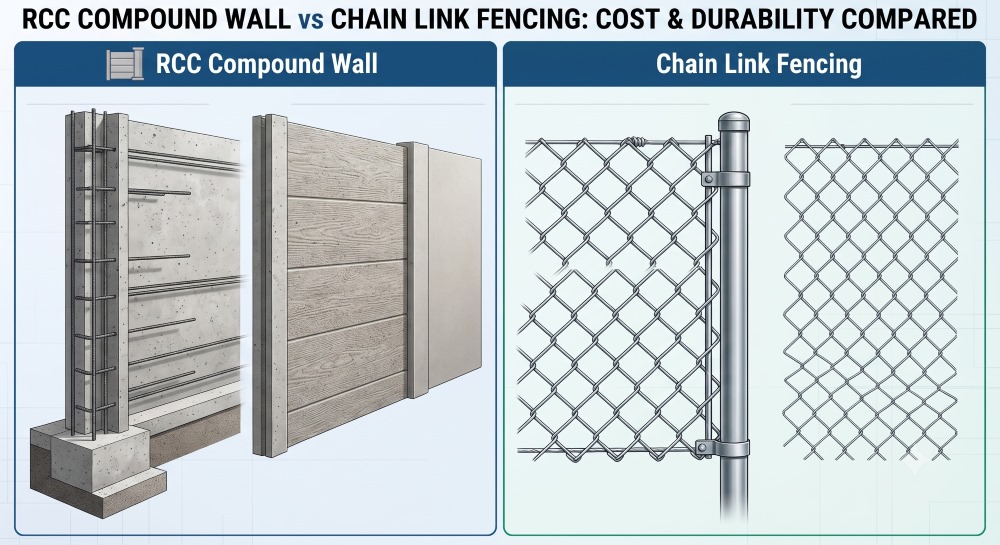
RCC Compound Wall vs Chain
Link Fencing: Cost and Durability Compared
Choosing between an RCC compound wall
vs chain link fencing is one of the first decisions homeowners, builders,
and facility managers face when planning a boundary. Get it wrong and you
either overspend on a solid wall you didn't need, or under-invest in security
and end up replacing a flimsy fence within a few years. This guide compares
both options on cost, durability, maintenance, and suitability, so you can pick
the right boundary solution for your residential or industrial property in
Maharashtra.
Arihant Fence has manufactured and
installed both RCC compound walls and chain link fencing systems for over 30
years across Mumbai and Maharashtra, giving us direct, on-site experience with
how each option actually performs over time — not just brochure claims.
RCC Compound Wall vs Chain Link Fencing: The Core Difference
An RCC compound wall is a solid, cast or
precast concrete structure — permanent, opaque, and built for maximum security
and privacy. Chain link fencing is a woven galvanized wire mesh strung between
posts — permeable, faster to install, and considerably lighter on both budget
and foundation requirements.
The RCC compound wall vs chain link
fencing decision usually comes down to three factors: how much privacy and
security you need, your budget, and how quickly you need the boundary
completed. Neither option is universally "better" — each suits different
property types and priorities, which is exactly why this comparison matters
before you commit.
RCC Compound Wall Cost in India
RCC compound wall cost depends heavily on
wall height, thickness, foundation depth, and whether you use cast-in-place or
precast panels. Compound wall construction cost India-wide typically runs
higher than fencing because it involves foundation excavation, steel
reinforcement, concrete casting or panel installation, plastering, and
finishing — each an added labor and material cost.
Precast RCC panels reduce cost and
installation time compared to cast-in-place walls, since panels are
factory-made and simply erected on-site with minimal curing time. For an
accurate quote on RCC compound wall cost for your specific site, our RCC compound wall manufacturing page covers
panel specifications and installation options.
Chain Link Fencing Cost Per Square Foot
Chain link fencing cost per square foot
sits well below RCC wall construction, since it needs only posts, tensioning
wire, and mesh panels — no foundation excavation or concrete curing time. This
makes chain link fencing the faster and more budget-friendly choice for large
perimeters, farmland boundaries, warehouses, and temporary or semi-permanent
site enclosures.
Material choice affects the final price:
GI (galvanized) chain link costs less than PVC-coated options, though PVC
coating adds corrosion resistance and a cleaner finish for visible boundaries.
For a detailed, itemized cost breakdown by gauge and coating type, see our complete chain link fence price guide.
Chain Link Fence Durability vs RCC Wall Lifespan
Chain link fence durability depends
primarily on coating quality. Hot-dip galvanized mesh with adequate zinc
density can last 15–20 years in most climates, while PVC-coated or stainless
steel variants extend that further in coastal or industrial settings. However,
chain link is still a wire structure — it can be cut, climbed, or damaged by
impact more easily than solid concrete.
RCC walls, by contrast, routinely last
30–50 years or more with minimal structural degradation, since concrete and
steel reinforcement resist most forms of physical damage that affect wire
fencing. The trade-off is that RCC walls need periodic plastering repair and
repainting to stay weatherproof, while galvanized chain link needs virtually no
maintenance beyond occasional tension checks.
Boundary Wall vs Fencing: Security and Privacy Considerations
Boundary wall vs fencing decisions often
hinge on privacy rather than pure security. An RCC wall fully blocks
sightlines, which suits residential bungalows, hospitals, and any property
where visual privacy matters as much as physical security. Chain link fencing
keeps sightlines open, which actually benefits industrial sites, warehouses,
and farms where visibility for surveillance and monitoring is an advantage
rather than a drawback.
For sites needing both structural
security and visibility, some facility managers combine the two — a low RCC
plinth wall topped with chain link or welded mesh panels. This hybrid approach
balances cost against the strengths of each material.
RCC Wall vs Wire Fencing for Industrial and Warehouse Sites
RCC wall vs wire fencing decisions for
industrial and warehouse properties usually favor wire-based systems, since
large perimeters make full concrete walls prohibitively expensive and slow to
construct. Chain link or welded mesh fencing covers more linear footage per
rupee spent and installs in a fraction of the time an equivalent RCC wall would
take. If your facility is specifically weighing fencing options for warehouse
security, our warehouse and industrial site security fencing guide
covers this in more depth.
Compound Wall Types in India
Compound wall types in India extend
beyond a simple RCC vs chain link choice. Common options include cast-in-place
RCC walls, precast RCC panel walls, brick masonry walls, and combination walls
with a masonry or RCC base topped by grills, mesh, or fencing. Each type
balances cost, construction speed, and appearance differently, and the right
choice depends on your property type, local regulations, and budget ceiling.
Chain link fencing for boundary use
remains the most common choice for agricultural land, under-construction sites,
and any property where a temporary or cost-effective perimeter is needed before
a permanent wall is built later.
Cost Comparison: Fencing Options at a Glance
A practical cost comparison fencing
options table helps clarify the decision:
RCC compound walls carry the highest
upfront cost but the longest lifespan and best security and privacy. GI chain
link fencing carries the lowest upfront cost with good durability when properly
galvanized, best suited to large perimeters and budget-conscious projects.
PVC-coated chain link sits between the two on cost, adding better corrosion
resistance and a neater appearance than plain GI mesh.
Best Fencing for Compound Wall Combinations
The best fencing for compound wall
projects often isn't a single material — it's the right combination for your
site. A residential property prioritizing privacy and long-term durability
suits a full RCC wall. An industrial site prioritizing speed, budget, and
visibility suits chain link. A farm or large land parcel benefits most from
chain link's lower material cost across long perimeters combined with periodic
tension maintenance rather than concrete's high fixed cost.
Why Choose Arihant Fence for Your Boundary Project
Whether you need an RCC compound wall,
chain link fencing, or a hybrid solution, Arihant Fence manufactures and
installs both systems directly from our Vasai East facility, giving builders
and facility managers across Mumbai, Thane, and greater Maharashtra
factory-direct pricing without distributor markups. Browse our full range of
boundary and fencing solutions on the Arihant Fence home
page.
Frequently Asked Questions
Is RCC compound wall or chain link
fencing cheaper? Chain link fencing is significantly
cheaper upfront, since it avoids foundation excavation and concrete curing
costs. RCC walls cost more initially but need less recurring maintenance over
their longer lifespan.
Which lasts longer, RCC wall or chain
link fence? RCC walls typically last 30–50 years with
proper maintenance. Well-galvanized chain link fencing lasts 15–20 years,
extending further with PVC coating or stainless steel.
Can chain link fencing provide enough
security for a home? Yes, particularly when combined
with a low plinth wall or topped with anti-climb features. For full privacy and
maximum security, an RCC wall remains the stronger option.
Is chain link fencing suitable for
industrial boundaries? Yes — it's the standard choice
for large industrial and warehouse perimeters, since it covers more area per
rupee and installs faster than an equivalent RCC wall.
Can I combine RCC wall and chain link
fencing on one property? Yes. A common hybrid approach
uses a low RCC plinth wall topped with chain link or welded mesh, balancing
structural security with cost efficiency.
Get Expert Help Choosing Your Boundary Solution
Not sure whether an RCC compound wall,
chain link fencing, or a hybrid setup fits your property and budget? Arihant
Fence's team can assess your site and recommend the right solution.
Visit Factory: Agarwal Industrial Estate, Unit 1, Plot No. 3, Sativali Kaman Road,
Valiv, Vasai East, Thane, Pin – 401208, Maharashtra, India Call: +91
93222 90173