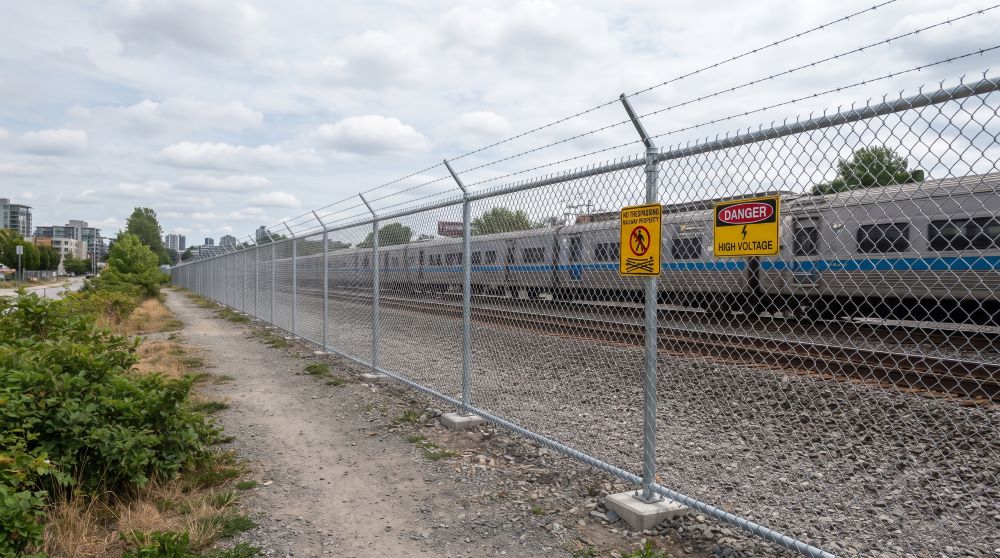
Railway Track Fencing: Preventing Trespassing on Transit Corridors
September 08, 2026 Super Admin Fencing Guides
Railway Track Fencing: Preventing Trespassing on Transit Corridors
Railway track fencing is one of the most consistently underfunded line items on Indian transit projects, right up until a trespassing incident forces the question of why it wasn't specified properly in the first place. Unauthorized access onto active tracks remains one of the leading causes of preventable railway fatalities in India, and in most cases, the gap traces back to a stretch of corridor left without adequate railway track fencing. For railway infrastructure engineers, safety compliance officers, government transit authorities, and fencing contractors, this guide covers what effective railway track fencing actually requires, from material selection to right-of-way compliance along Indian Railways corridors. With Indian Railways continuing to expand suburban, metro-adjacent, and dedicated freight corridors through 2026, the volume of new track requiring properly specified boundary protection is only increasing, making a clear, repeatable specification more important than ever for teams executing these projects at scale.
Why Railway Track Fencing Is a Safety-Critical Specification
Railway corridors run through a mix of dense urban settlements, semi-rural crossings, and open countryside, and each stretch presents a different trespassing risk that railway track fencing has to account for. In urban and peri-urban zones especially, informal footpaths across active lines form quickly wherever a boundary gap exists, and once a crossing pattern becomes habitual among the local population, it becomes far harder to close off later without community pushback.
Railway trespassing prevention barriers exist specifically to interrupt this pattern before it forms. A continuous, well-anchored railway track fencing system, installed early in a corridor's development, prevents informal crossing points from ever becoming an established habit, which is significantly easier than trying to reverse one after the fact.
Transit Corridor Safety Fencing: What the Specification Covers
Transit corridor safety fencing extends beyond simply lining the track boundary with wire. A complete railway track fencing specification typically addresses:
Fence height and rigidity suited to the trespassing risk of the specific stretch, urban, semi-urban, or open track
Anti-climb mesh at stations, platforms, and high-footfall crossing points
Gaps and gates required for authorized maintenance and emergency access
Drainage provisions at culverts and low-lying sections along the corridor
Signage integration warning of the electrified third rail or overhead line, where applicable
Our welded wire mesh systems, built from Grade 350 high-tensile steel with hot-dip galvanizing, are commonly specified for railway track fencing on stretches where a rigid, low-maintenance boundary is required over extended, largely unmanned distances.
Indian Railways Boundary Wall Standards
Indian Railways boundary wall standards typically define the required fence type and height by zone classification, since urban stations, suburban corridors, and open-line rural stretches each carry a different risk profile. Railway track fencing along suburban and metro-adjacent corridors, where footfall and informal crossing pressure are highest, is generally specified to a taller, more rigid standard than open rural stretches with minimal nearby population.
Our chain link fencing systems, supplied with PVC-coated and hot-dip galvanized finishes, are frequently specified on lower-risk open corridor stretches, while heavier welded mesh or an RCC compound wall is reserved for high-footfall urban sections where anti-climb performance matters more than cost efficiency.
Anti-Trespassing Fencing Solutions Along High-Risk Stretches
Anti-Trespassing fencing solutions need to be matched to how people actually attempt to cross, not just how a specification reads on paper. Near stations and informal settlements adjacent to the corridor, low fencing or gaps at gradient changes are routinely exploited as shortcuts, which is why railway track fencing specifications increasingly call for continuous height and rigidity through these zones rather than allowing a drop in standard at the edges of a station boundary.
Our concertina razor wire is sometimes layered onto the primary railway track fencing at particularly high-risk crossing points, adding a visible and physical deterrent above a standard mesh or chain link base without requiring a full height upgrade across the entire stretch.
Railway Right-of-Way Protection Fencing and Land Encroachment
Railway right-of-way protection fencing serves a second purpose beyond preventing trespassing, it also defends against gradual encroachment onto railway land, a persistent challenge along many Indian corridors passing through dense or rapidly urbanizing areas. Continuous, clearly demarcated railway track fencing gives ground staff and enforcement teams an unambiguous physical boundary to reference during encroachment surveys, which significantly speeds up resolution compared to corridors where the boundary line exists only on paper.
Applying Railway Track Fencing Across Different Corridor Types
Railway track fencing specifications shift depending on the corridor type and surrounding land use, and matching the fence to the actual risk profile avoids both under-protection and unnecessary cost:
Urban and suburban stations: taller, rigid anti-climb mesh with minimal gaps, reflecting the highest footfall and trespassing pressure
Metro-adjacent and dedicated freight corridors: continuous welded mesh or RCC compound wall, prioritizing long-term durability over frequent maintenance
Semi-rural crossings: chain link with periodic anti-climb reinforcement near known informal crossing points
Open rural track: cost-optimized chain link, sized primarily to deter livestock and casual trespassing rather than determined intrusion
Bridge and embankment approaches: fencing coordinated with structural design to avoid compromising drainage or maintenance access
For teams evaluating material trade-offs before finalizing a fencing package, our guide on welded wire mesh specifications and grades covers the gauge and aperture choices most relevant to long-distance railway corridor runs.
Common Gaps in Railway Track Fencing Execution
Even well-planned railway corridor projects run into recurring execution issues that undermine the intended benefit of the fencing:
Inconsistent fence height across adjoining contract packages, creating an obvious weak point where two contractors' work meets
Missing anti-climb detailing near stations, where trespassing risk is highest but is sometimes treated as a lower priority than open-track stretches
Delayed maintenance of damaged sections, which quickly become known informal crossing points once a gap appears
Corrosion from monsoon exposure going unaddressed on older galvanized sections, weakening the barrier well before its rated design life
Working with a manufacturer supplying ISO 9001:2015 certified material, with documentation available at dispatch, helps contractors and transit authorities avoid the certification gaps that commonly stall handover and audit sign-off on railway corridor projects.
Frequently Asked Questions
What makes railway track fencing different from standard boundary fencing?
It has to account for trespassing behavior specific to active rail corridors, informal footpath crossings, station-adjacent footfall, and electrified line hazards, rather than simple property demarcation.
Why is anti-climb mesh specified near railway stations?
Station areas see the highest pedestrian footfall and the greatest temptation for shortcut crossings, so a more rigid, harder-to-climb barrier is typically required there than on open rural track.
Does railway track fencing help prevent land encroachment as well as trespassing?
Yes. A continuous, clearly marked fence line gives enforcement teams an unambiguous physical reference during encroachment surveys, which speeds up resolution considerably.
What galvanizing standard is typically used for railway corridor fencing?
Hot-dip galvanizing, often specified up to 275g/m2 zinc density, is commonly used to withstand years of outdoor exposure with minimal maintenance.
Do railway fencing projects require material test certificates?
Yes. Transit authorities and EPC contractors typically require mill test certificates confirming steel grade and coating compliance before releasing payment milestones tied to fencing works.