
Complete Guide
to Welded Wire Mesh Specifications and Grades
If you're sourcing wire mesh for a
construction, industrial, or fencing project in Mumbai, getting the welded
wire mesh specifications right the first time saves you money, rework, and
site delays. Architects specify the wrong gauge, contractors order mismatched
panel sizes, and procurement teams end up paying twice for material that
doesn't meet load or corrosion requirements. This guide breaks down every
welded wire mesh specification you need — grades, gauges, mesh openings,
coatings, and IS code references — so you can select the correct mesh for your
project with confidence.
Arihant Fence has manufactured welded
wire mesh for over 30 years from our Vasai East facility, supplying architects,
contractors, and industrial buyers across Maharashtra. This article draws on
that manufacturing experience to give you technically accurate, field-tested
guidance rather than generic specifications.
What Welded Wire Mesh Specifications Actually Cover
Welded wire mesh specifications define
four core parameters: wire gauge (thickness), mesh opening size (the gap
between wires), coating type, and panel or roll dimensions. Every welded wire
mesh grade is a combination of these four factors, engineered for a specific
load, budget, or corrosion environment. Getting even one parameter wrong — for
example, choosing a light gauge for a security boundary — compromises the
structural integrity of the entire installation.
Unlike woven chain link, welded mesh has
every intersection fused, which is why welded wire mesh specifications place
heavy emphasis on weld shear strength alongside wire diameter. This rigidity is
what makes it the preferred choice for compound walls, concrete reinforcement,
and industrial partitioning.
Welded Wire Mesh Sizes and Gauge Chart
Wire mesh weight per square meter and
structural performance both depend directly on gauge. Here's a practical welded
mesh gauge chart covering the ranges most commonly specified in India:
●
Light gauge (14–16 SWG, roughly
1.6–2.0 mm): Suited to poultry enclosures, garden
partitions, and light-duty screening where load-bearing isn't a concern.
●
Medium gauge (10–12 SWG,
roughly 2.6–3.25 mm): The standard choice for
residential compound fencing, warehouse partitioning, and general construction
boundaries.
●
Heavy gauge (6–8 SWG, roughly
4.0–5.0 mm): Used for industrial security fencing,
high-security perimeters, and concrete reinforcement applications requiring
higher tensile strength.
Converting Welded Wire Mesh mm to Gauge
For welded wire mesh mm to gauge
conversion, remember gauge numbers work inversely to wire thickness — a lower
SWG number means a thicker, stronger wire. Always confirm the mm equivalent
with your supplier rather than relying on gauge numbers alone, since SWG, BWG,
and metric gauge systems aren't identical.
Mesh opening sizes typically range from
12 mm x 12 mm for fine screening up to 100 mm x 100 mm for general fencing and
reinforcement panels. Finer openings suit filtration, poultry, and
security-sensitive applications; larger openings reduce material cost for
boundary and reinforcement use where visibility or airflow matters.
Welded Wire Mesh Grades: GI, PVC-Coated, and Stainless Steel
Selecting the right welded wire mesh
grade comes down to matching the coating to your site's exposure conditions.
GI Welded Wire Mesh Specification
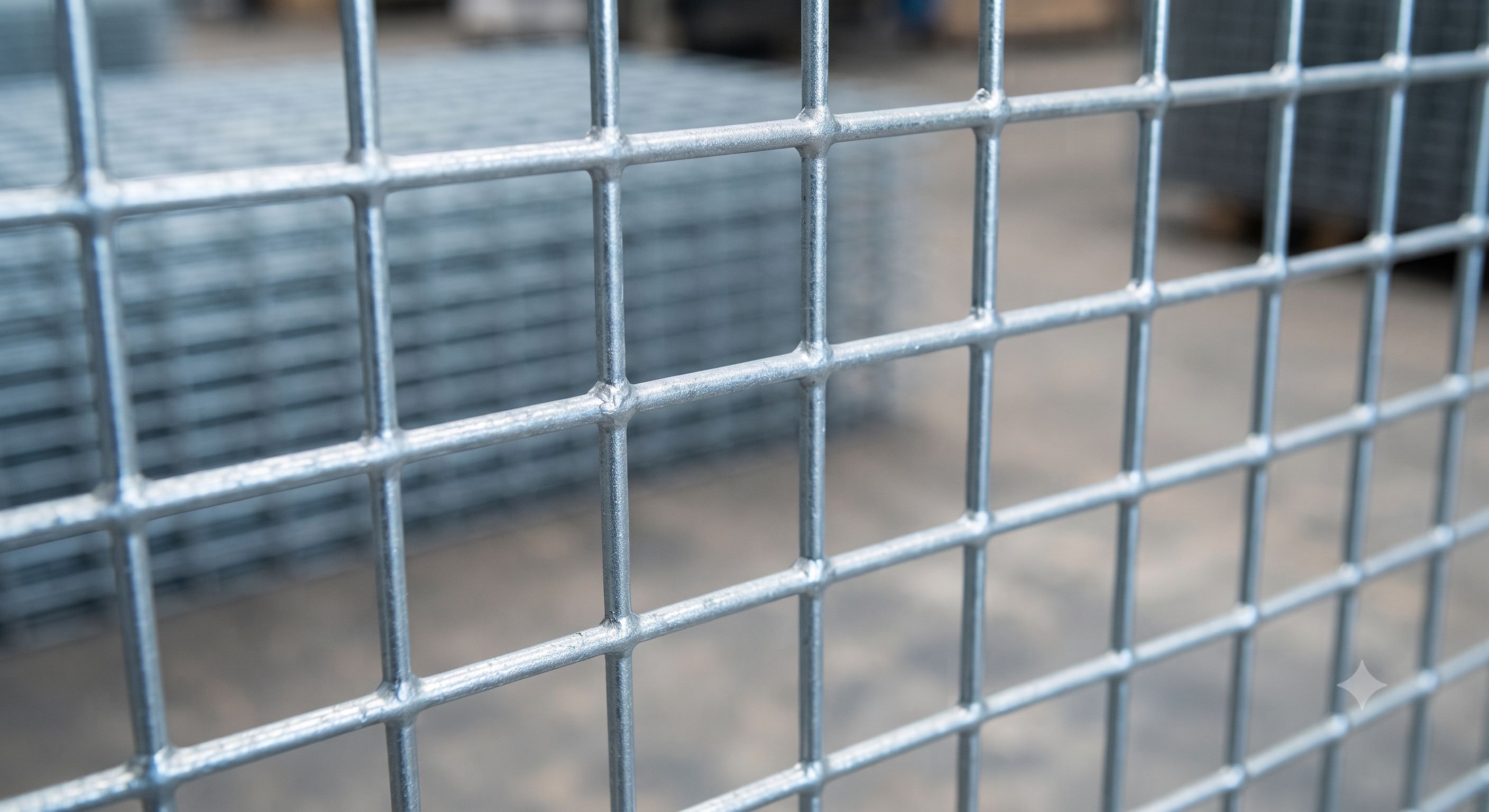
Hot-dip galvanized mesh, typically coated
to 275g/m² zinc density, offers strong rust resistance at the most economical
price point. It's the default choice for general fencing and construction in
Mumbai's humid, coastal climate. You can review our galvanized wire mesh manufacturing specifications
for exact coating and gauge options.
PVC-Coated Welded Wire Mesh
A polymer layer over galvanized wire
gives extra protection in marine or heavily industrial zones, plus a cleaner
finish for visible boundaries like township or commercial compounds.
Stainless Steel Welded Wire Mesh Specification
SS 304 or 316 grade mesh is specified
where corrosion resistance is critical — food processing units, chemical
plants, and coastal industrial sites. It costs more upfront but eliminates
recoating over the structure's lifetime. Full technical parameters are listed
on our stainless steel wire mesh specification page.
If your project instead needs flexible,
woven boundary material rather than rigid welded panels, compare these welded
wire mesh specifications against our chain link fencing options before finalizing
your order.
Welded Wire Mesh IS Code and Compliance Standards
For construction and industrial
procurement in India, welded wire mesh specifications should reference relevant
Indian Standard codes governing wire diameter tolerance, weld shear strength,
and zinc coating weight. Reputable manufacturers test every batch for
dimensional accuracy and coating uniformity against these benchmarks. When
evaluating suppliers, ask specifically for batch test certificates rather than
accepting verbal assurances — this is one area where procurement managers most
often get shortchanged.
At Arihant Fence, every manufacturing run
is audited for zinc coating uniformity and tensile strength before dispatch,
which is part of why builders and government contractors across Maharashtra
continue sourcing from us directly.
Calculating Wire Mesh Weight Per Square Meter
Wire mesh weight per square meter depends
on wire gauge, mesh opening size, and material density. As a general rule,
heavier gauges and finer openings both increase weight per square meter — more
steel occupies the same panel area. For accurate project budgeting, request a
weight calculation specific to your chosen gauge and opening size rather than
using generic online estimates, since coating thickness also adds measurable
weight, particularly with PVC coatings.
This weight figure matters for two
practical reasons: it affects transport and handling costs, and it's often used
by structural engineers to confirm post spacing and foundation load
calculations for reinforcement applications.
Choosing Welded Wire Mesh for Construction Projects
When specifying welded wire mesh for
construction in Mumbai and across Maharashtra, work through this sequence:
- Define the application — boundary
fencing, concrete reinforcement, or partitioning — since each has
different minimum gauge requirements.
- Assess
site exposure — coastal, industrial, or standard
urban — to determine whether GI, PVC-coated, or stainless steel is
appropriate.
- Confirm
mesh opening size against your security or
containment needs.
- Request IS code compliance documentation
and batch test data from your supplier before placing a bulk order.
If your project also involves a solid
boundary wall rather than mesh alone, our RCC compound wall specifications may be worth
reviewing alongside your mesh order, since many Mumbai sites combine both
systems.
Why Mumbai Buyers Choose Local Industrial Welded Wire Mesh
Suppliers
Sourcing industrial welded wire mesh in
Mumbai from a local manufacturer rather than a distant supplier reduces lead
time, transport damage risk, and logistics cost — all significant factors on
large industrial or infrastructure projects. Arihant Fence manufactures
directly from Vasai East, giving architects and contractors across Mumbai,
Thane, Navi Mumbai, and greater Maharashtra faster dispatch and direct factory
pricing without distributor markups. You can see our full range of fencing
systems on the Arihant Fence home
page.
Frequently Asked Questions
What welded wire mesh specification is
best for a residential compound wall? A medium-gauge
GI welded wire mesh (10–12 SWG) with a 50 mm x 50 mm opening is typically
sufficient for residential boundaries, balancing cost with adequate security
and rust resistance for Mumbai's climate.
How do I convert welded wire mesh mm
to gauge accurately? Use a standard SWG-to-mm
conversion chart, and always double-check with your supplier, since gauge
systems vary slightly between regions and manufacturers.
Is stainless steel welded wire mesh
worth the extra cost? For food-grade, chemical, or
coastal industrial applications, yes — the elimination of ongoing recoating and
corrosion-related replacement typically offsets the higher upfront price within
a few years.
What IS codes apply to welded wire
mesh in India? Relevant IS codes cover wire diameter
tolerance, weld shear strength, and galvanizing coating weight. Ask your
supplier for batch-specific test certificates referencing these standards.
Can welded wire mesh be customized for
non-standard openings? Yes. Most manufacturers,
including Arihant Fence, produce custom mesh opening sizes and panel dimensions
on request for projects with specific structural or security requirements.
Get Expert Help Selecting the Right Welded Wire Mesh
Specification
Choosing between gauges, coatings, and
mesh openings is easier with a technical consultation. Arihant Fence's
engineering team can review your project drawings and recommend the correct
welded wire mesh specification for your site conditions and budget.
Visit Factory: Agarwal Industrial Estate, Unit 1, Plot No. 3, Sativali Kaman Road,
Valiv, Vasai East, Thane, Pin – 401208, Maharashtra, India Call: +91
93222 90173